Yellowhammer
The canaries of the British countryside
 Some people walk with pods in their ears listening to podcasts or music, but when I am out either undertaking fieldwork or in my own time, the last thing I want to do is block out nature’s chorus around me. One of the delights of working with the Martin Down and Allenford Farmer Cluster and GWCT clients is being out in the middle of the farms or estates, listening to what is around me, the calls of the farmland birds and perhaps a migratory species flying over, the crickets and the rustle of mammals in the undergrowth. One bird in particular is very abundant in our corner of Hampshire, Wiltshire and Dorset, an iconic sparrow-sized bunting whose call is instantly recognised, even by my young daughter: the call of “little bit of bread and no cheese!”
I give you the yellowhammer (Emberiza citronella).
Identification
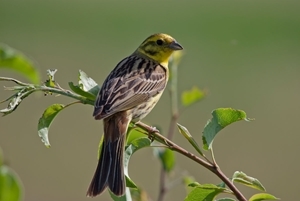
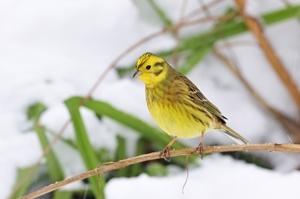
The yellowhammer is a sparrow-sized, bright yellow bird of farmland, woodland edge, hedgerows and heath. The male yellowhammer is definitely the more showy and striking of the sexes, with his bright yellow head, orangey chest and streaky brown back, often seen sat up high in bushes and hedgerows, singing their memorable song. The female buntings are duller, with more olive and brown tones, a paler yellow underbelly, and more pronounced patterns on their head with subtle dark markings.
- Size: Approximately 16cm, similar to a sparrow
- Call: ‘Tsik’ short sharp call as well as the longer call referred to
Behaviour and diet
Adults mainly feed on seeds and will flock together in the winter with other buntings, finches and sparrows to forage, while the chicks depend on insects and spiders for food.
Nesting
Yellowhammers nest on or close to the ground in ditch vegetation or at the base of short, thick hedgerows and scrub. They are most commonly found in hedgerows that have a wide margin or ditch. They often breed until the end of August, so cutting hedges before then can destroy nests. Females lay 2-6 eggs, incubated for 12-14 days, with chicks fledging after 10-13 days. Two or three broods per season are common.
Population
 This red-listed farmland bird has suffered significant decline since the mid-1980s, with a moderate decline since the mid-1990s due to winter resource limitations, the lack of overwinter stubbles, and a reduction in weed densities and nesting opportunities. But it has been seen that population declines were less steep where food availability and nesting opportunities were more abundant through stewardship, mainly arable options and hedge management, overwinter stubbles, supplementary feeding and reduced pesticides.
According to the BTO population estimates there are 700,000 breeding territories (2016) in the UK.
However, there is hope as there are several measures that can be undertaken to help this species increase:
- Maintain short, thick hedges and ditches with wide margins for nesting.
- Flower-rich margins are better for insects than grass margins.
- Do not trim hedgerows before September, as the late nests of yellowhammers are the most vulnerable.
- Arable land – Overwinter stubbles, wild bird cover crops or seed mixtures, unharvested cerals, tussocky grass margins, flower rich margins.
- Grassland – Fodder crops or small plots of wild bird cover to provide seed-rich habitat in a grassland area and provide longer grassed areas lefty ungrazed if possible.
- Hedgerow – Mosaic of hedgerow management, some cut and some uncut/laying/coppicing. Yellowhammers favour hedgerows less than 2m tall, no cutting in bird breeding season, and maintain thick bases to the hedges.
Facts
The scientific name, Emberiza citronella, is derived from the Old German ‘Embritz’ for bunting, and citrinella is from the Latin for a small yellow bird.
The English name is thought to have come from ‘Ammer’, another German word for a bunting, and was first recorded in 1553 as yelambre. Historic names include ‘scribble lark’ and ‘writing lark’.
Megan Lock
Advisory
Photo credit: Markus Jenny, Laurie Campbell