Amethyst deceiver
Don’t be deceived — they are similar but not deadly!
 The robin’s song has changed, the temperature has dropped (at last), and we have had some rain – hurrah! Autumn is nearly here and for lots of my friends it is their favourite season of the year. I do look forward to walks in the woods as the trees start to change; the colours range across the whole spectrum and everything seems quieter. The light changes and smell of autumn carries through the trees.
The one thing I am always on the lookout for is fungi. As most of the world of fungi is hidden out of sight underground, it can be overlooked and the fruit that is visible can be feared if you are not sure whether it’s poisonous or not, but fungi plays a crucial role in woodland ecosystems, being among the most important organisms in a woodland ecosystem; acting as recyclers through decomposition of dead material; essential drivers in the nutrient cycle; tree partners by forming mycorrhizal associations with tree roots, increasing the tree’s ability to absorb water and nutrients; habitat creators by building and maintaining healthy soils; and supporting biodiversity by providing a food source to mammals, birds and invertebrates, which in turn become prey for others.
Isn’t fungi incredible! It fascinates me that one only sees just a tiny fraction of the fungi as a whole, usually just the fruiting body (e.g. mushroom). Among the many fungi that appear in Britain’s autumn woodlands, few are as striking as the amethyst deceiver (Laccaria amethystina), and this is what I will be focusing on this month.
What does it look like?
- Cap diameter: 1-6cm
- Stem height: 4-10cm
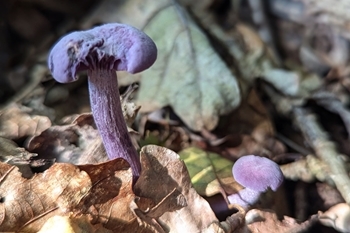
This small but beautiful mushroom is instantly recognisable when fresh, displaying vivid shades of violet and amethyst that seem almost unnatural against the browns and greens of the forest floor. The cap is usually between 1 and 6 centimetres across and ranges from deep violet to rich amethyst-purple. Young caps are convex, becoming flatter with age and often developing a shallow central depression. The cap surface is smooth when moist and may become slightly scurfy as it dries.
The gills are one of the most useful identification features. They are thick, waxy and widely spaced, coloured a similar purple shade to the cap. Even when the cap fades, traces of lilac often remain on the gills, helping experienced foragers and naturalists recognise older specimens, with a slender stem that usually matches the purple shade of the cap.
It is known as a ‘deceiver’ because its colour fades with age and dry weather, resembling an entirely different species.
Lookalikes
As with all wild fungi, positive identification is essential and you should always seek an expert to confirm species if unknown.
- Common deceiver (Laccaria laccata) — After the amethyst deceiver has faded it can be confused, but this species is more orange-brown or flesh-coloured when fresh.
- Lilac bonnet (Mycena pura) — A more pinkish tone, with a thinner stem and radish-like odour.
- Lilac fibrecap (Inocybe geophylla var. lilacina) — TOXIC. Lilac in colour when young but they may fade to a light brown with age.
Where and when to find it
The amethyst deceiver can be seen growing in broadleaved woodland, particularly where beech, oak and birch are dominant, but they can also be found in coniferous woodlands among the damp leaf litter and moss, often appearing in scattered groups. End of August to November.
- Widespread across Britian and Ireland and also found across parts of Asia and North America.
- Excellent locations include the New Forest, the Forest of Dean, Epping Forest, the woodlands of the Lake District, and countless ancient woodlands across southern England.
Ecology
Akin to other Laccaria species, the amethyst deceiver is an ectomycorrhizal fungus, meaning it forms a symbiotic relationship (mutually beneficial partnership) with the roots of trees. Through this relationship, the fungus helps trees absorb water and nutrients such as phosphorus and nitrogen from the soil, while the tree supplies the fungus with sugars produced through photosynthesis. This partnership is an important component of healthy woodland ecosystems, which means you are unlikely to see this fungus far away from trees.
Conclusion
The amethyst deceiver is one of Britain’s most enchanting woodland fungi, perhaps only behind the fly agaric with its visions of pixies and childhood (and perhaps adulthood) hopes of seeing one. Its ecological role as a mycorrhizal partner helps sustain healthy forests, while its brilliant purple colouring makes it a favourite among mushroom enthusiasts and photographers. So, as always, take only but photographs and leave nothing but footprints and enjoy the start of autumn!
Megan Lock
Advisory
Photo credit: Megan Lock