Clouded yellow butterfly
Flashes of yellow in the summer sunshine!
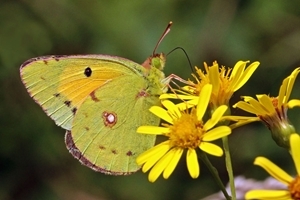 Summer is well and truly here, and don’t we know it here in Hampshire, but also with the warmer weather in fly the migrants – but rather than birds, I am referring to a butterly! I have seen an influx of clouded yellow butterflies (Colias croceus) in this last week. In particular, on one farm within the Martin Down Farmer Cluster, which I am the Facilitator for, I recorded in good number. It is always such a joy to see them, especially knowing how far they have come!
The clouded yellow is one of the most striking butterflies found in Europe, known for its vivid golden-yellow wings edged with black borders, and bright green eyes. It is a species that is a favourite among butterfly enthusiasts who like to see an colourful visitor.
The clouded yellow is one of the truly migratory European butterflies and a regular visitor to Britain and Ireland. Although these butterflies can be seen every year, the species is famous for occasional mass immigrations and subsequent breeding, which are fondly and long remembered as ‘clouded yellow years’, and after seeing so many this week, I think we might be in for one!
Identification
The clouded yellow is a medium-sized, golden-yellow butterfly with bright yellowy-orange upper wing surfaces, lined with broad, dark edges, and a yellowy-green underside – when you see one, you know! It rests with its wings closed; two silver-white spots can be seen on the hindwings in this pose and they also have large, striking green eyes.
- Wing span range (male to female): 57-62mm
Life cycle
Like all butterflies, the clouded yellow undergoes a complete metamorphosis consisting of four stages: egg, larva (caterpillar), pupa (chrysalis), and adult butterfly.
It prefers open habitats, particularly chalk grassland where their life cycle begins when a female lays her eggs singly on the leaves of food plants, such as clovers, birdsfoot trefoil and lucerne. The eggs are elongated and pale in colour, making them difficult to spot among the vegetation. After several days, the eggs hatch into small green caterpillars. The caterpillars then feed on the leaves of their host plants and grow rapidly. Their green colouring provides excellent camouflage, helping them avoid predators such as birds and insects. As they grow, they shed their skin several times in a process known as moulting. During this stage, they consume large amounts of plant material to store the energy required for their transformation.
Once fully grown, the caterpillar forms a chrysalis attached to vegetation. Finally, the adult butterfly emerges with crumpled wings that must be expanded and dried before flight. Adult clouded yellows feed on nectar from a wide variety of flowering plants.
Habitat
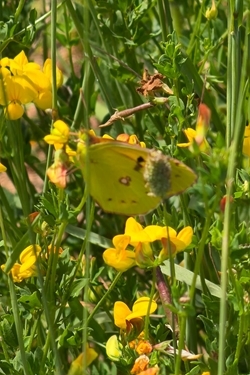 Clouded yellows may be seen in any habitat – gardens, parks, farmland and open species-rich grassland, congregating in places where the larval foodplants grow. As clovers are still commonly cultivated, this species has no difficulty locating breeding habitat in the modern farmed countryside. In southern England, there is a preference for unimproved species-rich chalk downland, and that’s why I have been seeing so many as the farmers in the MDFC create and manage hectares of species-rich habitats!
Abundance and distribution
The abundance of the clouded yellow varies greatly from year to year. Across southern Europe and North Africa, the butterfly is relatively common and breeds successfully throughout the warmer months. However, farther north, especially in the United Kingdom, its numbers depend heavily on migration.
Some years witness spectacular influxes known as migration years, when favourable winds carry thousands of butterflies across the English Channel from France and other parts of continental Europe. The summers of certain years have seen exceptionally large arrivals, with butterflies appearing in coastal counties and spreading inland across Britain. They are unable to survive winter in the UK, but they may become more common, or even residents, if temperatures rise as a result of climate change.
Importance in the ecosystem
The clouded yellow butterfly plays an important role in healthy ecosystems. As an adult, it acts as a pollinator, transferring pollen from one flower to another while feeding on nectar. This helps many wildflowers reproduce and contributes to the biodiversity of grassland habitats.
Butterflies are often considered valuable indicators of environmental health because they are sensitive to changes in weather, habitat quality and climate. The presence of these butterflies often suggests that habitats contain a rich variety of flowering plants and suitable host species for caterpillars.
Interesting facts
The clouded yellow butterfly is famous for its long-distance migrations. Despite its delicate appearance, it can travel hundreds of kilometres across seas and continents, assisted by favourable winds.
Clouded yellows are also among the fastest-flying butterflies in Europe. Their rapid and powerful flight makes them challenging to identify and photograph, often requiring patience from butterfly recorders like me!
Globally, the clouded yellow remains widespread and is not currently considered threatened. Nevertheless, habitat loss, agricultural intensification, pesticide use and climate change can affect local populations and the availability of food plants. So keep a look out for this striking butterfly when you are out and about this summer and marvel at how far it has travelled to get here!
Megan Lock
Advisory
Photo credit: Charles Sharp, Megan Lock