A new project designed to bring together almost half a century of unique research with field studies of hens to understand what determines breeding success in one of Britain’s most iconic upland birds has been established by the Game & Wildlife Conservation Trust (GWCT) across northern England and Scotland.
After spending decades helping shape modern grouse management through its scientific studies and monitoring programme, the GWCT has embarked on its most ambitious study yet into the factors driving red grouse breeding success – the Maternal Grouse Project.
GWCT scientists have monitored the same grouse moors across England, Scotland and Wales using standardised spring and summer counts since the early 1980s. Those unrivalled long-term datasets have revealed an increasingly concerning trend.
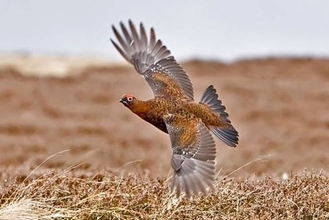 Over the past decade, red grouse populations have experienced a series of sharp declines. In spring 2025, GWCT’s long-term monitoring recorded an average 40% decline in pair counts across England and a 34% decline in Scotland following a poor 2024 breeding season. Summer brood counts revealed a further decline in adult birds, with numbers falling by 36% in England and 29% in Scotland. While some moors have experienced repeated breeding failures over successive seasons, in 2025 the remaining adult birds did produce more young when compared to the previous year, with an average young-to-old ratio of 1.4 in England (0.9 in 2024) and 1.3 in Scotland (0.6 in 2024).
While grouse populations have always fluctuated naturally, recent years have seen several widespread breeding failures and sharp declines across moors managed under a wide range of different systems, suggesting that multiple interacting factors are now influencing productivity and limiting breeding success.
The new study represents the culmination of almost 45 years of grouse research, combining one of the world's longest-running red grouse monitoring programmes with intensive field studies following individual hens throughout the breeding season. The project aims to answer one of the biggest questions facing upland conservation today: why are some grouse populations recovering while others continue to experience poor breeding years?
Unlike previous studies that focused on individual pressures such as parasites, disease or predation in isolation, the Maternal Grouse Project investigates the whole picture. Researchers are examining how a hen’s condition before breeding is influenced by nutrition, habitat quality, weather, parasites, insect availability and other environmental factors, and how these influences ultimately affect nesting success and chick survival.
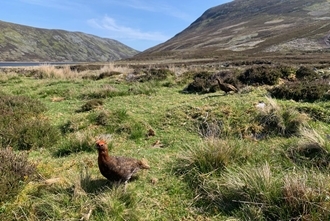 Each spring, researchers capture and radio-tag hens before carefully following them throughout the breeding season. They monitor nesting attempts, egg production, hatch success and chick survival while also measuring heather quality, cotton grass production, cranefly emergence, weather conditions and parasite burdens. By combining these detailed field measurements with decades of population data, the Trust hopes to identify the subtle interactions that determine whether a breeding season succeeds or fails.
The study is now in its fourth year in northern England, has recently expanded into north-east Scotland and will expand into southern Scotland in 2027, allowing researchers to compare whether the drivers of breeding success differ between landscapes and regions.
In March, we caught and tagged 60 hens across four long-standing study sites in the North Pennines, and 51 hens across four new sites in the Scottish Highlands.
Nick Hesford, director of GWCT Scotland, says: “For decades we’ve known what grouse populations are doing because we’ve monitored them consistently across the uplands. What the Maternal Grouse Project allows us to understand is why some populations have remained consistently low and what’s been driving recent declines and failures to breed successfully.
“By following individual hens from before they lay until their chicks fledge, we’re beginning to uncover how nutrition, weather, habitat and disease interact to influence breeding success. It's a level of understanding that simply hasn't been possible before.
“Expanding the project from northern England and across north-east and southern Scotland allows us to test whether drivers of hen condition and productivity differ between regions, and to strengthen comparisons across landscapes and management systems.”
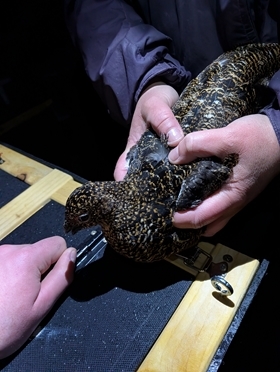 Leah Cloonan, GWCT Uplands Advisor, has been monitoring red grouse as part of the project in the English uplands for the past four years. Here hens across our four North Pennine study sites have been tagged and tracked, their habitat and food availability studied along with worm burdens and health testing. Leah explains how the fieldwork is carried out:
“It’s not just body condition and parasite burdens that may affect grouse breeding productivity. Their habitat and food sources can also play a role. To investigate the role of these, the vegetation at each site is also monitored. For six weeks starting in March, prior to nesting, we take heather samples every week, the main food source of red grouse. This will be analysed to assess its nutritional value and whether this changes over the sampling period. We have also monitored the emergence and abundance of cottongrass flower heads, an important alternative food source. These data will give us an insight into the quality of the food available for the hens at a crucial time, just before they start to lay and incubate their eggs.
“In the last week of April we start to locate nests. Once we locate a nest, we note the clutch size, measure the eggs and insert a small temperature data logger into the nest lining. This data logger will give us invaluable data into how many times the hen comes off of her nest to feed, and an accurate indication of date of nest failure or hatch date.
“Once hatched, we note the number of hatched eggs, and we start invertebrate sampling in a typical brood foraging area to assess chick food availability in the seven days following hatching. The availability of craneflies is important for the survival of young grouse chicks in the early days, but it is not the only factor which influences the survival of young chicks. This year we have introduced a new element to the study which is the capture of rainfall data on a site by site basis. Damp ground is important for the emergence of key invertebrate species, but too much rainfall can have a detrimental effect on the survival of chicks.”
Nick adds: “The ultimate aim of the Maternal Grouse Project is to identify factors limiting red grouse breeding success and translating this into practical guidance that can help estates build more resilient grouse populations and deliver more consistent grouse bags in the years ahead.
“This understanding will also help guide future, modern, sustainable grouse moor management and conservation in the face of climate change, poor breeding years and increasing legislation and regulation.”
Notes to editors
The Game & Wildlife Conservation Trust – providing research-led conservation for a thriving countryside. The GWCT is an independent wildlife conservation charity which has carried out scientific research into Britain’s game and wildlife since the 1930s. We advise farmers and landowners on improving wildlife habitats. We employ more than 60 post-doctoral scientists and other research staff with expertise in areas such as birds, insects, mammals, farming, fish and statistics. We undertake our own research as well as projects funded by contract and grant-aid from Government and private bodies. The Trust also has a dedicated professional advisory service to make sure that the results of its research are easily available to farmers, landowners, gamekeepers, and others delivering practical conservation.
For information, contact:
Eleanor Williams
Telephone: 07592 025476
Email: ewilliams@gwct.org.uk