By Joe Stanley, Head of Sustainable Farming, the Allerton Project
352 minutes. After 18 months in which the Sustainable Farming Incentive (SFI) - Defra’s flagship mechanism to help farmers deliver the food and nature outcomes on which this nation depends - was closed, farmers had less than six hours to submit their applications for 3-year periods of funding before the door was once again slammed shut.
The Allerton Project – home to an unbroken run of agri-environmental schemes since the 1990s and progenitor of the research by which many of the AES options exist today – was one of the tens of thousands of unlucky businesses which failed to submit an agreement, though not for want of trying.
Having spent weeks of staff time crafting a scheme which balanced food production with proven environmental outcomes to replace our CS Mid-Tier scheme which expires in December, we were online at 10am to submit the scheme only to find that ‘computer said no’; technical issues associated with our concurrent, small SFI23 agreement meant that we were unable, despite 352 minutes of increasing panic and hours spent on hold with a clearly overwhelmed RPA helpline, to submit before the window closed at 3:52pm.
Like many thousands of farm businesses around the country for whom these SFI schemes were to be an integral part of their business planning and landscape management for the coming years, we are now left wondering ‘what next’? It feels like this is one of those rare days that will live long in the collective memory; everyone will remember the chaotic and nerve-wracking process of navigating the RPA portal and desperately trying to input their scheme details as emails pinged in warning that the budget was 25%, 50% and 75% spent. Relief for those who managed to complete the process in time; despair for those who did not.
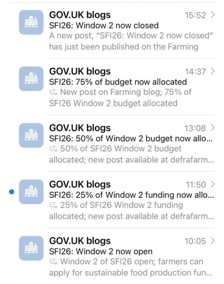 352 minutes which will live in infamy
The stories are already circulating; the nature-friendly farmer who got into a car at 1000 to drive to collect an award for their efforts, arriving at the hotel at 4pm with laptop under arm only to find that it had just cost them £90,000 over the next three years. The farmer with a mandatory TB test who found not only that they’d had a herd breakdown, but that they’d missed the SFI window too. The farmer who was attending hospital that day and will now have a financial black hole in the farm accounts to explain to their bank manager.
It wasn’t supposed to be like this, and it’s no way to be forced to run a business – let alone a strategic national industry.
At the heart of the problem is clearly an inadequate budget: £233m of SFI commitments flew out of the door at the rate of £662,000 per minute. As discussed in a previous blog - SFI: A decade on, still not delivering - Game and Wildlife Conservation Trust – in real terms Defra’s farming budget is decreasing across the life of this parliament and has not risen with inflation since 2013 when it was directed solely at per-hectare area payments. We have lofty environmental and climate targets for agriculture funded with petty cash.
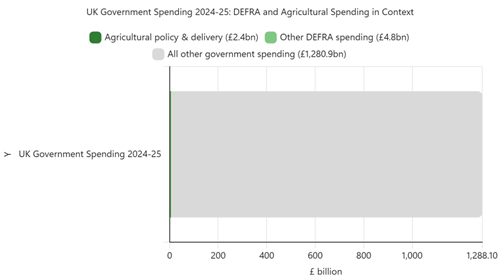
Can you spot it? Defra’s total budget accounts for 0.56% of government spending: agricultural policy & delivery a mere 0.19%
After a decade of preparation for the complete structural shift from area-based direct subsidy payments for food production to ‘public money for public goods’ for environmental delivery, there is clearly now huge willingness and demand on behalf of English farmers to engage with and deliver the new schemes. Yet having been led up the hill and promised the tools to do the job in the sunlit uplands beyond, most farmers have instead been abandoned at the summit and exposed to the full force of the storm of global events which is even now breaking over their heads.
In Scotland, Wales and Northern Ireland, more measured approaches to post-CAP policy have been adopted with the result that farmers in those jurisdictions are still largely in receipt of full-fat support payments. In Europe, governments are piling crisis support payments atop basic CAP payments. This isn’t to argue for or against those systems, but it’s a measure of how dangerously exposed and disadvantaged most English farmers have now become in comparison to our competitors.
It’s worth taking stock of the current situation in England. Farmers were originally promised that SFI would be a rolling scheme, engagement with which would only be limited by the ambition of individual farms. It was supposed to be simple and egalitarian. As we have seen, it’s now a first-come, first-served scramble favouring those who have paid to have an agent deal with their claims or who weren’t misguided enough to engage with earlier iterations of the scheme (now in its fifth guise!)
The new Higher-Tier scheme will better suit many farms and estates, but for the last year has been trickled out via an invitation-only process and to all intents and purposes is not an immediately viable option even for those who have historically engaged with these more ambitious levels of AES. Demand vs ability to process applications is simply too high.
Landscape Recovery is the most ambitious level of the new Environmental Land Management package, yet Round Two closed in 2023 and of the 56 projects selected only three have moved to implementation.
The recent Farming Roadmap 2050 made clear that – far from increasing spending on farming and the environment in the next parliament – this government plans to let regulation and the private sector do more of the lifting and to draw back from paying farmers under SFI; indeed, even the next SFI window will be different to SFI26, with more changes and a promise of ‘spatial targeting’ which will once again exclude many farms who are wondering how to cover the shortfall in their accounts left by the withdrawal of area-based payments but farm the wrong side of an arbitrary line on a map.
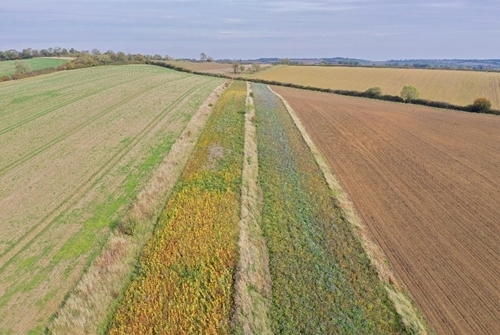 30 years in situ; but what about next year?
And what of private finance? The reality today is that BNG, nutrient neutrality, soil carbon and the whole range of other voluntary schemes are worth a few hundreds of millions of pounds annually, a mere fraction of the existing Defra budget, and are – again – very spatially targeted, leading to the haves and have nots. While organisations such as the Environmental Farmers Group (EFG) exist to help farmers make use of these markets, any thought that private finance will rise to the required occasion by the end of this decade are based on some fairly heroic assumptions by a government which seems desperate to offload the commitments made under previous administrations.
Defra has remained very quiet since the closure of Window 2, with no repeat of the triumphal press releases of March 2025 trumpeting the speed at which the budget was exhausted. In data which has been subsequently released, it would seem some 12,200 farm businesses were successful in submitting an application; the farming press was reporting that some 40,000 businesses were eligible. However, it also has to be recognised that many of those successful applicants are known to have submitted poor-quality schemes in desperation as the clocked ticked down and the computer repeatedly ‘said no’ to the options which had been planned. These farms are likely now locked-in to these schemes for the next three years, delivering neither for nature nor farm finances.
Looking ahead, analysis by Tom Scrope of Soil Benchmark shows that for the remainder of this parliament, demand for SFI will continue to outstrip budgetary supply. For a May 2027 window funded by expiring agreements, some 60% of applicants will again miss out given the average scheme size (£20,700) seen on 22nd September. Defra now has more difficult decisions to make; with a rigid budget, do they further water down payment rates, reduce the agreement cap or move to exclude certain farm businesses via ‘spatial targeting’? None would deliver for either nature or farm finances.
The 352 minutes of SFI26’s application window should serve as a wake-up call to this government that the system we have is not fit for purpose; SFI is being asked to deliver too much. Food production, nature recovery, climate action, crisis relief, cheap retail prices. If we were actually to price that list up honestly, what would the total be? Right now, that debit is falling on the shoulders of farmers who are those least able in the food system to pay.