By Joe Stanley, Head of Sustainable Farming, Allerton Project
For the past decade the Allerton Project has worked alongside Syngenta to deliver a valuable long-term look at the realities behind the transition from ‘conventional’ farming practices within a combinable cropping system to a more ‘conservation’ and ‘regenerative’ approach.
In 2017 the Allerton team began a five-field, four-crop rotation utilising three 1.5ha plots in each field:
- Conventional (heavy tillage, primarily ploughing)
- Light-till
- Direct-drill
Data was collected over the first five years of the project with establishment method being the only significant variable. From 2018, this project was adopted across four fields of a light-land site in Kent (farmed by Andy Barr and supported by NIAB) to contrast with the clay soils of Loddington.
From 2022, the protocol was modified, with the ‘light-till’ plot becoming the ‘regenerative plot’, with a range of variables being introduced such as introduction of FYM, use of biostimulants and novel fertilisers (supported by Yara).
The data generated over the last decade has been hugely revealing, demonstrating the importance of context in farming operations and how the same action in two different places can have very different results.
At the headline level, the first five years of the project demonstrated that the move towards reduced tillage had beneficial impacts for natural capital, ecosystem services and carbon across the board at both sites, and particularly at Loddington.
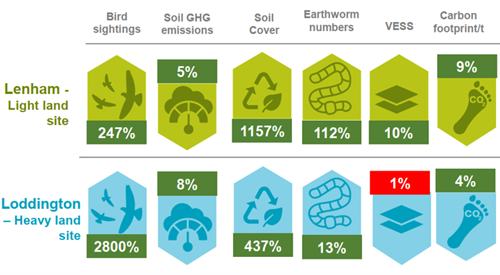 Figure 1: Amalgamated environmental metrics from trial
However, when it came to output from crop production, although the Kent site did see a significant financial benefit of some £100/ha improved profitability across its first four years (plough vs direct drill), at Allerton the benefit was more marginal at around £20/ha on average across the first five years. This reflected a number of very challenging seasons for cropping on our heavy soils, and the fundamentally greater productivity of Andy’s farm in this period.
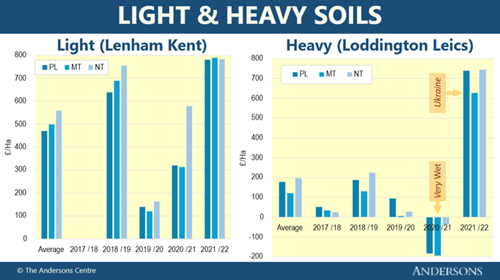
Figure 2: Net profit/ha
Four years later, we are looking forward to a second big review of the project after harvest 2027, when we will be able to re-assess both the long-term trends in the conventional and direct drill plots, but also the impact of the more regenerative practices in the ex-min-till plots.
One of the most interesting interim findings coincides with this year’s growing of Syngenta’s X-Terra® hybrid wheat, Europe’s first commercially scalable hybrid wheat which we were delighted to host the first UK trials of for harvest 2026 integrated into our long-term project.
Hybrid wheat has been an aspiration for breeders for decades, but the challenges are much greater than for well-established hybrid crops such as barley, maize and OSR. As with all hybrids, Syngenta’s X-Terra® looks to deliver more stable and significant agronomic benefits than might be seen in conventional varieties, not least a more significant root mass which might help growers in increasingly dry spring and summer periods.
The X-Terra® was planted in the field where we are combining all of our ‘regenerative’ practices (as applicable) into a single plot, year on year. However, the most exciting data is emerging from the application of field-standard rates of FYM and soil organic matter (SOM) levels. In the two reduced tillage plots, SOM has been slowly increasing over the past decade but this seems to have accelerated in the ‘regen’ plot with the addition of annual FYM which has increased from 7.5% SOM in 2017 to 8.5% in 2026. By contrast, the conventional cultivation plot has decreased by around 1% in that same time. The direct drilled, no-FYM plot has increased by about 0.5%.
The impact of that additional SOM was very visible in the cropping this year; the heavily cultivated plot was, on average, about 40% shorter than the FYM/direct drilled plot, with the direct drill/no FYM plot coming in somewhere between them. The progression of soil colour was also striking, becoming visibly darker as OM levels increased. We also recorded some 958 worms/m² in the FYM/direct drilled plot versus 283 in the heavy cultivation plot.
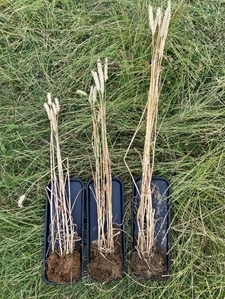
Figure 3: From L-R ‘plough, direct drill, direct drill + FYM
Impressively, the ‘regen’ plot delivered 82% more straw mass at harvest than the plough-based plot, alongside 8% greater yield (a respectable 8.54t/ha in a year when the farm average was 7.7t/ha), despite initial establishment being 12% poorer.
There is huge value in long-term research trials such as these, and we are very grateful to Syngenta for working with us over the past decade on a trial which has now assumed national significance; adding innovative products such as X-Terra® to the mix continues to push the boundaries of the sort of practical on-farm research that is our foundation at the Allerton Project, and will hopefully help signpost means for farmers and growers to build greater resilience into their businesses in a challenging commercial environment.