By 1998, in England, only 773 black grouse males remained, restricted to the Pennine Hills in northern England and in 1999 the black grouse was designated a Biodiversity Action Plan (BAP) species.
Between 1995 and 2015 a series of focused multi-partner funded projects, led by the GWCT, targeted remaining black grouse strongholds in the Pennines. These initiatives used agri-environment schemes to encourage farmers to restore habitats, including creating pockets of scrubby woodlands and reducing grazing on the moor fringes to improve the insect-rich swards favoured by chicks.
This resulted in initial increases in breeding success with number of males doubling by 2014 to 1,437. During this period GWCT also successfully translocated wild males and females into the Yorkshire Dales, establishing new lekking groups and expanding their range south. Since then, the English population has stabilised at 1-2,000 displaying males, with 96% of the remaining population living on the edges of moors managed for driven red grouse. Here, they benefit from the protection from generalist predators and the retention of moorland habitats.
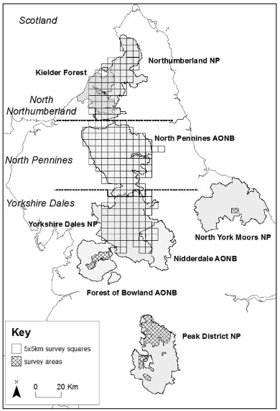
Figure 1: The location of the 5×5km grid squares surveyed in North Northumberland, North Pennines and the Yorkshire Dales, and the other areas surveyed during the Black Grouse survey, 2014.
Despite these encouraging increases, black grouse in England remain severely vulnerable due to their small population and restricted range. GWCT annual lek counts in spring and brood counts in August show that adult survival is generally high, except in harsh winters, but population growth is limited by poor breeding productivity. Poor breeding is linked to high rainfall when chicks hatch in June, lack of insects and chick predation by stoats.
In 2023, the GWCT successfully applied for funding for a two-year project, being granted £162,750 from Natural England’s Species Recovery Programme. The Black Grouse Range Expansion Project aimed to safeguard black grouse against potential negative impacts of climate change through instigating measures to increase breeding success, and by expanding range into the North York Moors using a conservation translocation technique. This project saw the first ever fitting of GPS tags to black grouse in the UK, which were used to monitor brood movements and allow researchers to count chick droppings, take invertebrate samples and measure vegetation with minimal disturbance. This project also saw black grouse successfully reintroduced into the North York Moors, with birds settling, displaying at leks, breeding and producing chicks.
In 2026, the GWCT was granted £396,508 from Natural England’s Species Recovery Programme for a 33-month project; Range Expansion and Habitat Management for Black Grouse Conservation. This is complemented by £10,000 of funding from BASC Wildlife Fund.