Saving an icon of the uplands
 The Range Expansion and Habitat Management for Black Grouse Conservation Project is funded by Natural England’s Species Recovery Programme. This project will undertake a black grouse national survey to assess population changes since the last survey in 2014. This data will inform a Species Distribution Model that will be combined with feasibility studies to identify priority areas for targeted range expansion via conservation translocation in northern England. In addition, the project will evaluate the effects of cattle grazing on key habitat characteristics of moorland fringe grasslands and associated usage by GPS-tagged black grouse to inform better habitat management.
You can follow our story here if you are interested in learning more about who we are and what we’re aiming to achieve through this project.

About black grouse
Lyrurus tetrix (Linnaeus, 1758)
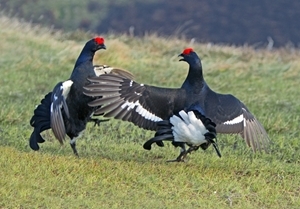 A grouse of moorland and forest edge, black grouse are best known for their early morning spring-time gatherings, called ‘leks’, where the males gather to compete for the attention of females. They display by fanning out their elaborate lyre-shaped tails and inflating their necks to signal their vigour and defend their territory. Their song consists of a long, dove-like bubbling coo. The hens arrive at the lek to pick the overall fittest male, which they will mate with.
Males are jet black with long, curved tail feathers. They have a slim white stripe in the wing and white feathers under the tail. Females are well camouflaged, with finely barred brown and black plumage and have a cackling call. The female takes all responsibility for nesting and rearing the chicks.
Black grouse favour a mosaic of habitats on moorland and marginal farmland that are near to woodland, and the species initially benefited from the planting of commercial forestry plantations following the Second World War. Now these plantations have matured they have become unsuitable for the species. Changes in land management have taken a toll on the population in modern times.
Project objectives
The project has three main objectives:
- To assess changes in the distribution and abundance of black grouse since the last national survey in 2014
- To build a black grouse Species Distribution Model, combined with feasibility studies, to target future range expansion efforts.
- To evaluate the effects of cattle grazing on key habitat characteristics of moorland fringe grasslands and associated usage by GPS-tagged black grouse to inform better habitat management.
National survey
Black grouse are red-listed as a species of high conservation concern. In England, they are now largely restricted to the North Pennines, which includes parts of County Durham, Northumberland, Cumbria and North Yorkshire. Here, numbers remain broadly stable, fluctuating between 1-2,000 displaying males over the last 25 years. More recently, black grouse were reintroduced into the North York Moors via a conservation translocation technique.
The GWCT-led previous national surveys of black grouse in 2002, 2006 and 2014, with core areas in the North Pennines being counted every year. Clearly, there is a need for more up-to-date information on black grouse distribution and abundance. The survey is planned for spring 2027, where trained observers will count the number of males (and females) attending leks at dawn. This information will allow us to quantify the changes in distribution (persistence, extinction, expansion) of black grouse in England.
Species Distribution Model and range expansion
The second phase of the project will combine the results from the national black grouse survey with environmental variables to parameterise a Species Distribution Model to identify priority range expansion opportunities. The feasibility of restoring black grouse into priority ranges will also be assessed following IUCN guidelines and DEFRAs ‘Reintroductions and other conservation translocations: code and guidance for England – Principles 1 and 2’ (DEFRA, 2021). This will determine the conservation needs for black grouse in priority ranges and evaluate whether reintroduction would be an acceptable option based on the availability of suitable connected habitat mosaics and predator management being undertaken in these areas.
Following this process, we will target further assisted range expansion to the top priority area in northern England following existing protocols and methods used when successfully translocating wild black grouse into the Yorkshire Dales and the North York Moors. This aspect will be evaluated in 2028 with Natural England and donor sites in the North Pennines to assess whether there are surplus wild birds available for translocation under a conservation translocation license. A sample of birds will be then equipped with GPS tags to allows us to follow settlement patterns, survival and lekking behaviour.
Cattle grazing and habitat usage
Phase three of the project aims to support better management of breeding habitats for black grouse. We will conduct a pilot study to evaluate the effects of cattle grazing, using geofencing technology, on key habitat characteristics of moorland fringe grasslands occupied by black grouse in Northern England. We will undertake baseline surveys and measure vegetation and key invertebrate responses to cattle grazing, and in relation to control non-grazed areas. This pilot study will demonstrate whether key insect groups, which black grouse chicks feed on, can be increased by appropriate grazing.
To better understand key habitats used throughout the year, we also aim to catch ten female black grouse and equip with GPS tags. This data, collected remotely, will allow us to assess habitat requirements at a local and landscape scale which can inform appropriate land management practices.