Written by Lilla Gyorkos, GIS and Lowland Wildlife Recovery Placement Student
Kestrels were once a common sight in the wider countryside, often seen hovering over fields and road verges. Whilst 2026 was a good breeding season for kestrels, they are still in decline nationally and are on the UK Amber list of species of conservation concern.
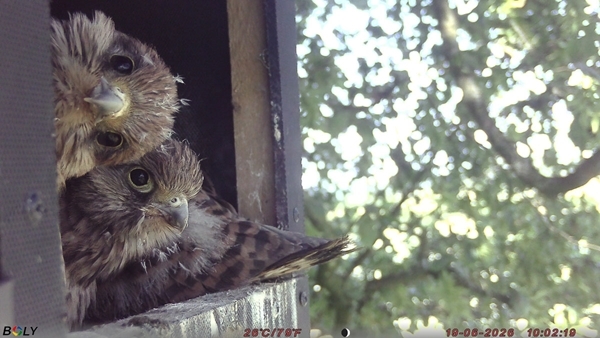
Reduction in suitable nest sites and accidental secondary poisoning from feeding on contaminated rodent prey has been suggested as potential reasons for kestrel decline. Over the past two years, the kestrel monitoring project led by Dr Francis Buner, Head of Wildlife Recovery at the GWCT, set out to improve our understanding of the reasons behind the decline of the species. Over 120 nest boxes were installed across Hampshire, of which 20 were installed with motion-sensitive cameras in both years.
Kestrels do not build their own nest and will happily occupy specifically made nesting boxes. This allowed us to study nesting preference by installing boxes in pairs, with one box in a barn and one on a tree within a maximum of 500 metres of each other. The cameras were used to record how often the parents brought back prey items to the box, what types of prey items they were feeding to their young, and whether this differs between barn and tree boxes.
How was 2026 different from 2025?
In 2026, the project was extended from one to three farmer clusters in the South of England. In total we installed 50 new boxes during the past winter, of which 11 have had nesting kestrels already in their first year.
Like in 2025, the results for this year suggest that barn boxes might be the preferred nesting site, but being only in the second year of the project, the sample sizes are still too small to draw any significant conclusions. Interestingly, among the six failed breeding attempts this year, four broods were predated in tree boxes.
This was an exciting new insight as the project expanded over a larger area. Predation events allow us to explore beyond which sites are preferred to whether and why certain sites are more likely to successfully fledge young. Increased chance of predation in tree boxes might be a reason for seeing more barn boxes raise successful young.
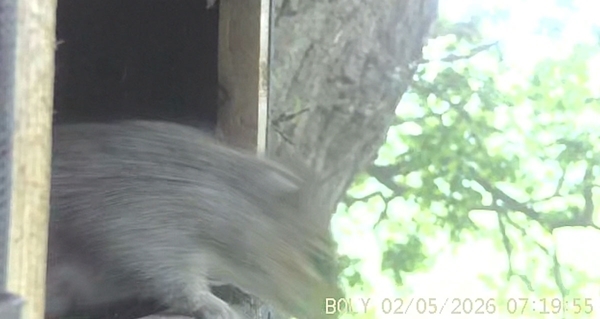
Squirrel seen fleeing a tree nest box with incubating female in it. Captured on video on a motion-activated camera.
Kestrel diet between the two years and the link to breeding success
2026 was a good breeding season for kestrels. Within the Selborne Landscape Partnership the number of successful broods has gone up from 12 in 2025 to 16 this year, whilst the number of nest boxes has stayed the same. On average there was one more egg and one more young per brood in 2026 compared to 2025, and the number of ringed young more than doubled from 30 to 67. What could have caused this difference?
Voles and other small mammal prey like mice form the major part of the kestrel diet. In 2026, small mammals made up a higher proportion of the recorded prey items brought to feed the young, and they were seen bringing less birds, insects and reptiles (see Fig 1).
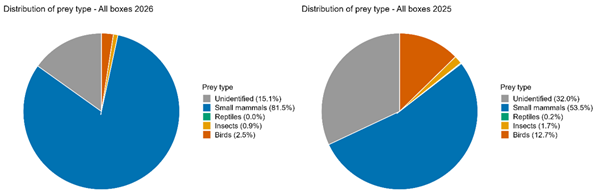
Figure 1: Proportions of prey types brought to feed the young by parents in 2026 (left) and 2025 (right).
Vole populations roughly follow a four-year cycle, where peak abundance years are followed by a crash in vole numbers in the following year, after which they gradually increase over one or two years to reach a new peak. Years with high vole numbers typically result in good breeding seasons of their predators that rely on them, including kestrels, which was the case this year.
Furthermore, a combination of higher prey availability and milder weather has meant that, like many other bird species, kestrels started breeding earlier this year. The average egg-laying week was five weeks earlier, with most kestrels laying eggs at the beginning of April in 2026, compared to the beginning of May in 2025. Having an earlier breeding season is advantageous for kestrels, as it coincides with high prey availability, making it more likely for young to survive and fledge.
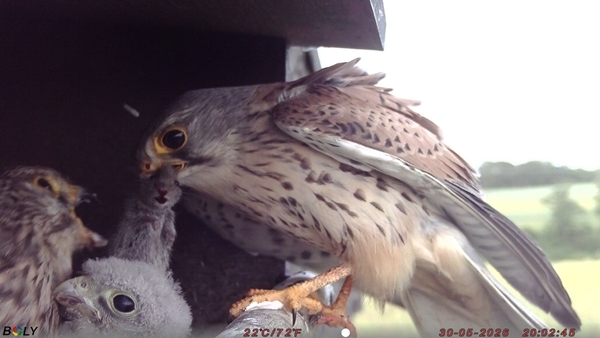 Male kestrel exchanging a vole with the female at their nest box, with one of the young chicks waiting to be fed. Females will feed prey to chicks in their first few weeks, whilst the male is mostly responsible for hunting. Voles form the major part of the kestrel diet. Good vole years are often linked with a good breeding season for kestrels as there is a steady supply of food for the young. Photo taken by Perdix Ltd motion-activated camera.
How will this study benefit kestrels
Old trees and open straw barns used to be a common nesting site for kestrels, but with the loss of these structures, they have become more reliant on man-made nesting boxes. This study is expected to help gain a better understanding of the limiting factors behind nesting success at boxes, such as available prey and nest predation. The findings will be used to produce best-practice guidelines for installing nest boxes in the most suitable locations. Furthermore, new funding obtained by Natural England’s Species Recovery Programme this year will help extend the study further to examine whether kestrels nesting in trees are less likely to feed their young with voles and mice contaminated with rat poison, compared to kestrels nesting in barns, where rat poison is far more likely to be administered.
As a placement student, I was very lucky to be part of the second fieldwork season of this exciting new project. This was my first time taking part in a conservation field research project and it gave me an invaluable insight into the many practical aspects that go into planning and carrying out such a project, from initial contact to farmers to accounting for when the weather or equipment don’t work as expected. The varied behaviours of kestrels were fascinating to observe. After this experience I feel more prepared and excited to work in conservation in the future.