By Dr Mike Swan, Senior Advisor
A couple of weeks ago I was privileged to be invited to the parliamentary premiere of BASC’s new wildfowling film, Call of the Marsh. This is not an instructional film, nor a wildfowling tale; rather it is an explanation of what coastal wildfowling is all about, featuring wildfowlers themselves talking about what they do and why.
The film has been made in collaboration with The Origins Foundation, and is mostly shot on the marshes of the Ribble estuary, with interviews out there on the foreshore, or in the wildfowlers’ sheds, where they store and tend their gear. For me, the striking part about the film is the way in which it captures wildfowling as a living heritage and spiritual experience, with a wonderful explanation of the deep connection to and care for the marsh.
Preston and District Wildfowlers Association Chairman Chris Kelly along with Lytham and District WA chairman Andy Lee jointly sum up that care in many ways by explaining the club approach to self-regulation, with their own voluntarily agreed bag limits, and restrictions on the number of days when the marsh is shot, to ensure that their harvest is modest and sustainable. Chris’s words epitomise this when he says: “Why would we want to go and annihilate the birds? We might just want to come out and do this again.”
The film also has a strong theme about the voluntary conservation works that clubs carry out across the half a million acres of marsh that they manage around the country. Providing relatively safe nesting sites for home breeding ducks is a case in point; there must be thousands of duck nesting tubes deployed by clubs all around our coasts. These provide safety from ground predators, while hiding nests and eggs from crows, and are evolved from the willow duck nesting baskets introduced from Holland and pioneered by the GWCT’s predecessors over half a century ago.
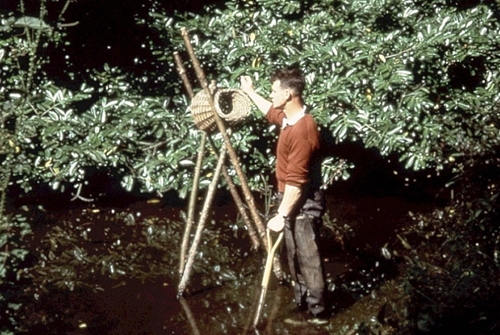 Nesting basket on the River Avon at GWCT HQ, circa 1970s.
Wildfowlers are ordinary people, but as Dr Robbie Kroger of The Origins Foundation was quick to recognise, they are also extraordinary people with a real love of what they do and the wonderful wild places where they pursue their sport. Wildfowling is generally at its best when most people would consider the weather pretty horrible. A dull grey dawn with a ripping gale at flight time brings the perfect conditions for keeping the ducks and geese down to a level where the fowler stands a decent chance of a shot or two.
The noise from the wind helps to mask the sound of a shot, keeping any disturbance of the flighting birds to a minimum, so it is hardly surprising that wildfowlers relish the sort of wild weather that sends most people indoors. Chris Kelly’s words really do sum this up when he says, “I think every wildfowler gets a bit agitated when the wind blows.”