By Maia Tollerton, Lowlands Placement Student
As a placement student in the Scottish Lowlands department, I’ve enjoyed spending the first few weeks getting stuck into some fieldwork, counting partridges.
 Partridge counts are an important part of the work the Scottish Lowlands team does through the PepsiCo FAB project. Grey partridges are not only an iconic bird of UK farmland, but they’re also key biodiversity indicators, especially for invertebrates and good habitat. Monitoring and analysing the trends in population size over time is also crucial for informing us on the effectiveness of wildlife management strategies, such as the special Balgonie partridge wildflower mixes the farmers have sewn.
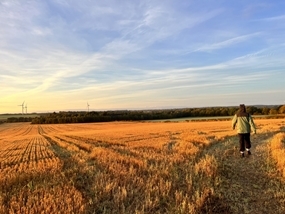
Surveys consist of walking along every other tramline in each field on the farm, braced with binoculars, scanning the field to spot and identify any coveys. Identification can be quite difficult, especially when there’s a covey of 10+ on the other end the field you’re surveying, and you need to simultaneously count, age and sex them. However, through lots of practice, and a lot of partridge-looking rocks, I’ve definitely improved in my identification skills.
We conduct surveys for three hours when partridge are most active, at dawn and dusk. This has involved some pretty early mornings and late nights, but the sunrise and sunsets we’ve seen have made it more than worth it. Thankfully for us, partridge are fair weather birds, so we only survey in ideal partridge conditions, when it’s dry and not too windy!
 After three repeats per field, we’ve finished partridge counting for the season and can begin analysing our results. Comparing our results to previous years, it looks like partridge population size hasn’t increased from last year but have remained high relative to densities across the rest of the UK . This is exciting news, showing the management efforts used on the farms continue to benefit grey partridge.
I’ve thoroughly enjoyed my first taste of fieldwork with the Scottish Lowland Department, especially getting to see firsthand how the wildlife management strategies used by the PepsiCo FAB project enhance farmland biodiversity. I’ve also improved my identification skills and learnt how to use data collection tools, which I will no doubt draw on and develop further throughout my placement year.