 By Jayna Connelly, Science Communicator
Solitary bee anatomy is crucial for both the way they live their lives and also for us identifying them. But at first glance it might be easy to confuse solitary bees for flies, wasps or flying ants. Understanding their anatomy can help us better understand them and their conservation needs.
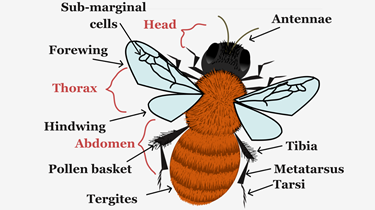
The first thing to consider is if the specimen has two or four wings. Flies known in Latin as Diptera have two wings – “Di” meaning two and “ptera” meaning wings. Wasps, ants and bees are all part of the order “Hymenoptera”, meaning “membranous wings”. All wasps, ants and bees typically have four wings and a relatively obvious separation between their thorax (upper body) and their abdomen (lower body), creating a distinctive waist.
To tell bees apart from their relatives, it helps to look at their body hair. Although many flower-visiting insects contribute to pollination, bees are especially effective because they are typically much hairier. Bees also tend to have heart-shaped faces and longer tongues for accessing nectar.
Behaviour can be another useful clue. Honeybees and wasps are often slower and louder in flight, while solitary bees are frequently quieter and faster moving. This can make them difficult to observe closely. Scientists often need to catch specimens for detailed identification, particularly during habitat surveys. For hobbyists, genus level identification is often possible in situ but digital cameras have revolutionised our ability to provide ad-hoc recordings for your local area.
The crucial role of antennae
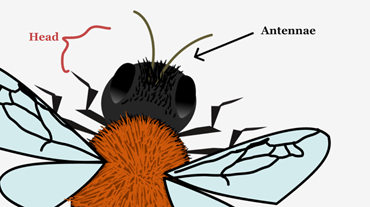 A bee's antennae are highly specialised sensory organs covered in thousands of tiny receptors called sensilla. These allow bees to detect smells, tastes, vibrations and chemical signals in their environment.
Using their antennae, bees can sense pheromones, carbon dioxide levels, humidity and even weak electrical fields. While these abilities may sound complex, they are essential for locating flowers, finding mates and monitoring environmental conditions.
The tip of the antenna is particularly sensitive to taste, often more so than the bee's tongue. Male solitary bees usually have longer antennae than females, which is thought to help them detect female pheromones. Long-horned bees (Eucera spp.) take this to the extreme and are renowned for their exceptionally large antennae.
Legs built for pollen collection
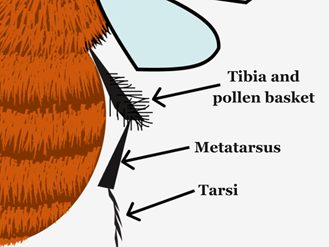 The tarsi, which form the bee's feet, help provide grip on irregular floral surfaces, climb narrow stems, clean the antennae and other body parts, and make precise movements while handling flowers. In many ways, they function like tiny fingers.
The tibia is one of the largest segments of the leg. Its large surface area makes it ideal for carrying pollen, and in many species it is covered with specialised pollen-carrying hairs known as scopa. Female solitary bees tend to have far denser scopal hairs than males, allowing them to collect pollen and transport it back to the nests they create for their young.
Together, these hairs form structures commonly known as pollen baskets. Solitary bees hold pollen on their bodies using specialised hairs and electrostatic forces. This differs from honeybees, which mix pollen with nectar to create tightly packed pellets.
This makes honeybees more efficient at holding on to pollen and carrying it back to their hive – a good thing for honey production but not so good for actually pollinating the flowers they visit. Therefore, solitary bees’ less efficient pollen sticking system actually makes them more efficient at cross-pollination. From the point of view of a healthy ecosystem or crop, this makes solitary bees incredibly important.
Solitary bee species such as Dasypoda – commonly known as Pantaloon bees have particularly large and distinctive pollen baskets.
The belly of the bees
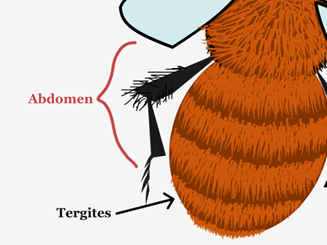 The abdomen of a solitary bee can also play an important role in pollen collection. In some groups, specialised hairs beneath the abdomen form a pollen brush, which is particularly distinctive in leafcutter bees (Megachile spp.). Rather than carrying pollen on their legs, these bees transport it underneath their bodies, often giving the abdomen a bright yellow appearance when loaded with pollen.
The abdominal segments themselves are known as tergites. These often create the coloured bands and patterns that help us identify different species. Some bees have densely haired tergites, while others have contrasting colours, hair patches or distinctive side markings. Many of these features require close inspection, often with magnification, but they can be invaluable for accurate identification.
A flight system under the microscope
A bee's forewings and hindwings work together as a single flight system. During flight, they are connected by a row of microscopic hooks called hamuli, which link the hindwings to the forewings.
The larger forewings provide most of the power, generating lift and steering the bee through the air. The smaller hindwings also contribute to lift but are particularly important for stability and balance.
Wing venation, the network of veins that runs through a bee's wings, is often one of the most useful features for identifying different groups of bees. These veins create a series of enclosed spaces known as cells, and the shape and arrangement of these cells varies between bee groups, rather like a family fingerprint.
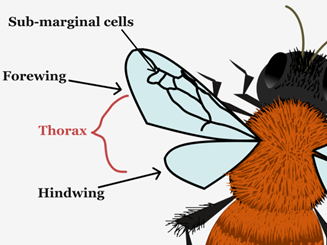 Studying wing venation usually requires a microscope. These patterns act rather like a family fingerprint. One of the key features that bee recorders look for is the number of submarginal cells. These are a row of cells found near the front edge of the forewing, just below the wing tip. Most solitary bees have either two or three submarginal cells, making them a useful character for narrowing down an identification.
Leafcutter bees, mason bees, wool-carder bees and resin bees typically have two submarginal cells. Mining bees, furrow bees, blood bees, flower bees and Pantaloon bees generally have three submarginal cells. For many bee recorders, this is one of the first microscopic features checked when confirming an identification.
Beyond what we see
Understanding solitary bee anatomy is about more than learning the names of body parts. The shape of their wings, antennae, legs and pollen-carrying structures reveals how they forage, nest and interact with their environment. Being able to recognise individual species means we can record, monitor and protect them. Understanding how solitary bees are adapted to live, means scientists can identify the habitats and resources different species need, helping to guide their conservation and protect these vital pollinators for the future.
If you want to learn more about how GWCT are working to conserve these fascinating species follow this link to our solitary bee appeal and support our research on the easily overlooked, ground-nesting solitary bees that are likely flying right under your nose!