Owen Williams, wildlife artist and GWCT Wales Chair and Trustee
There’s been a total of 16 significant wildfires in Wales covering a total of 10,662 hectares since early May. As I write this eight of these are showing up on real-time satellite data as either still burning or have major hotspots indicating that the fire continues to smoulder underground in the peat. The area of important peatland, scrub and woodland damaged in Wales is significantly larger than the combined figure for England and Scotland which currently stands at 4,800 hectares. Tied to the disproportionately large figure is the fact that most of these large wildfires have been very close to the highly populated South Wales valleys, suggesting arson as the primary cause.
Whilst it is widely acknowledged that arson is a major problem and every effort must be made to change the delinquent mindsets of disaffected youths within these communities, this is not going to be a quick and easy fix. Meanwhile there’s wide agreement that we must also reduce the build-up of wildfire fuel loads on our moorland that intensify the severity, spread and damage caused by wildfires. The government’s newly adopted light-touch management approach to our uplands of reducing livestock grazing and more recently what is effectively a ban on prescribed burning in England will inevitably lead to a further and highly risky increase in wildfire fuel loads in our uplands, particularly if Wales, Scotland and Northern Ireland adopt the limiting of prescribed burning as a moorland management tool.
As the wildfires of this year have proved when we allow fuel load to build, the rest is pure physics. We have hotter, harder to contain and thus more damaging wildfires. The results are widespread ecological damage and the loss of thousands of years of stored carbon in the very upland peat that government and eNGOs say must be protected at all costs.
Submissions by wildfire experts from Exeter University’s FireLab and the National Fire Chief’s Council to Defra’s 2025 ‘Heather and Grass Burning’ consultation were emphatic in their views regarding the risks associated with legislative changes that effectively increased levels of fuel load on our upland blanket bogs, but these appear to have been ignored. The reason seems clear: key advisors to government are stating confidently that the only approach needed is rewetting as this will make our upland blanket bogs saturated and sphagnum dominated and thus resilient to wildfire when it strikes.
The reality is that IUCN’s simplistic, yes/no ‘degraded’ and therefore re-wettable, metric that underpins the newly adopted policy takes no account of the naturally existing hydrological complexities between moors, or indeed even across individual moors. Worse than this, a key advisor to the IUCN and Natural England in his submission to the recent Defra Wildfire consultation ignored these complexities and narrowed down on prescribed burning stating it was responsible for drying out blanket bog so much that they had become unnatural upland heath dominated by heather, rather than sphagnum.
The prevailing impression given is that all our blanket bogs were perfectly wet and sphagnum dominated before humans started burning them and encouraging heather to grow. The picture is far more complex than this with peat stratigraphy showing a natural ebb and flow between sphagnum and heather dominance dictated by climate variation throughout the Holocene. Known periods of extremely wet hyper-oceanic weather, often lasting for several hundred years, saw rapid peat accumulation, these were interspersed by warmer and drier continental weather slowed peat accumulation and, on some uplands, saw the natural degrading of blanket bog peat. The last such wet event was the Little Ice Age (1400-1800) since when our climate has progressively become warmer and drier, resulting in the re-establishment of heather as the dominant blanket bog species. As we know the current trajectory for our uplands is drier still due to climate change.
This is not to ignore the human use of those landscapes such as post war draining to dry some moors out to improve livestock grazing, but if we are going to use the single tool of rewetting to future-proof them against wildfire damage, we need to take a far more empirical approach to understanding how much human activity has damaged them. A proper and fully transparent review of the evidence and an assessment of the implications of regulation change is essential in this process, but this hasn’t happened.
The belief that prescribed burning dries out peat and destroys sphagnum comes from a paper within the 2016 EMBER Study published by Leeds University. However, several experts from different academic institutions contest the findings of this paper, which was subsequently heavily critiqued for poor experimental design and analytical flaws and deemed to be unreliable. Furthermore, there’s a significant body of published science, including GWCT’s own research, that contests the view that prescribed burning is anywhere near as damaging as is now being accepted within policy circles.
Regardless, Defra moved quickly and before any consultation on wildfire to regulate against prescribed burning, a valuable management tool that reduces wildfire fuel load. With the reduction of livestock grazing this leaves rewetting as the only mitigation against severe wildfire damage on our uplands, leaving many questioning how broadly applicable this sole measure is, and how effective it will be.
A close look at the naturally occurring high hydrological variability of our uplands dictated by topography, aspect, altitude and not least underlying geology shows that however much we attempt to rewet by blocking drains or creating contour bunding large areas of moorland will remain highly vulnerable to significant wildfire damage.
It also doesn’t help when rewetted areas that have not burned in a wildfire are publicised across the media as proof that rewetting will save our uplands. That has just happened here in Wales following the 2025 and 2026 wildfires covering a huge expanse of the Elan Valley catchment. After a fact-finding visit to view the damage caused by this year’s wildfire the IUCN Peatland Programme and the Wales Peatland Action Group pointed to the “impressive delineation between the restored site and the boundary of the burnt area”. Their conclusions were that continued rewetting of these upland and other locations across the UK would make them resilient to wildfire in the future.
To put this all into context, those areas of contour bunding totalled little more than 50 hectares of the combined wildfire footprint of 13,000 hectares. The Elan Valley Trust has plans for further rewetting, but as these uplands were never drained, realistically any rewetting is limited to more contour bunding and gulley blocking. If we look at the areas where this is possible it still leaves huge expanses of that open upland vulnerable to future wildfire damage if no other measures such as grazing and prescribed burning are considered.
Since the terrible wildfire destruction caused across many upland areas of the UK hit the headlines and people rightly raised the issue of high fuel loads rewilders and conservation NGOs and rewilding groups have doubled down on the narrative that rewetting will come to our rescue.
Whilst nobody can deny the value of repairing damage such as drain blocking, attempting to prevent peat erosion by revegetating and reprofiling haggy areas of upland, even a quick investigation of the ecohydrology of our upland blanket bogs shows the practical limitations of this singular approach to wildfire mitigation. Exaggerating the benefits of rewetting and ignoring the ongoing risk of high wildfire fuel loads only serves to create divisions in a conversation which should be far more nuanced, evidence led and inclusive of all stakeholders.
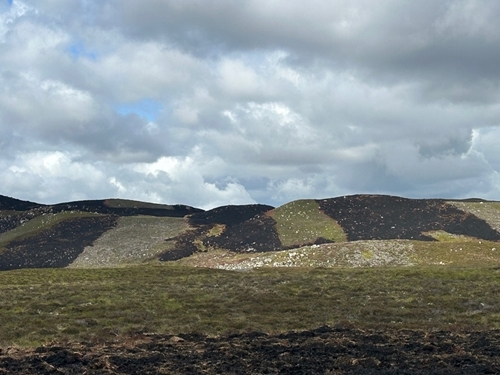
A photograph taken by the author after the 2025 Carrbridge/Dava wildfire. This begs two questions; how would one rewet that landscape? And, what caused the large green areas to remain unburned?
Thankfully a group of academics within Future Landscapes Forum have tried to inject a more balanced perspective on the realities of what the important tool of rewetting can deliver in their newly published position statement accessible at www.futurelandscapesforum.com