By Jayna Connelly, Science Communicator
When people think of bees, they usually picture honeybees in hives or bumblebees buzzing between flowers. Yet most of Britain's bee species live a very different life. Around 70% of our wild bees nest underground, quietly engineering tunnels, chambers and nurseries beneath our feet.
For many, a patch of bare ground may appear lifeless. In reality, it can support hundreds, sometimes thousands, of bees engaged in behaviours that are only just beginning to be understood. The more scientists look, the more fascinating ground-nesting bees become. What we know today may be only the tip of the iceberg.
Underground Engineers
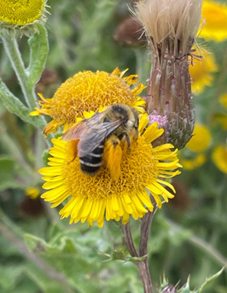 Ground-nesting bees excavate burrows in soil, creating nests that can range from simple tunnels to intricate networks of passages and brood chambers. Each female typically constructs and provisions her own nest, gathering pollen and nectar to feed the next generation.
But not all species go about their work in the same way.
Take the spectacular pantaloon bee (Dasypoda hirtipes), named after the enormous pollen-collecting hairs on its hind legs that resemble baggy trousers. Females are enthusiastic excavators, producing conspicuous spoil heaps around their burrows. Yet rather than leaving the excavated soil at the entrance, they actively brush it away, creating a cleared area around the nest. Why they do this remains uncertain. Does it help them relocate the entrance more easily? Reduce the risk of collapse? Or make it harder for parasites to find them? Whatever the reason, it highlights how even seemingly simple nesting behaviours can be surprisingly sophisticated.
Bee Motorways
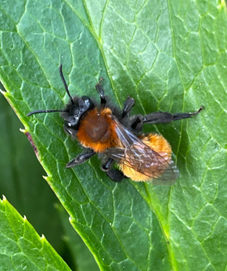 Perhaps the most intriguing courtship strategy of all is found in some mining bees (Andrena). Instead of waiting at flowers or nest sites, males create scented "motorways" by marking routes along hedgerows, bushes and other landscape features with pheromones. They then spend hours patrolling these aerial highways, flying up and down in anticipation of a receptive female.
The remarkable thing is that, despite these highly visible male displays, females are rarely observed using these routes. The motorways can attract large numbers of males, yet very few studies have documented how females respond to them or how they choose a mate once they arrive. For such a conspicuous behaviour, it remains surprisingly mysterious.
More commonly, males patrol nesting aggregations, where they eagerly await emerging females. In some species, hundreds of males may criss-cross a nesting site in a frantic search for mating opportunities. When a female emerges, a scramble often follows, with multiple males grappling to be the successful suitor.
Solitary... But Not Always
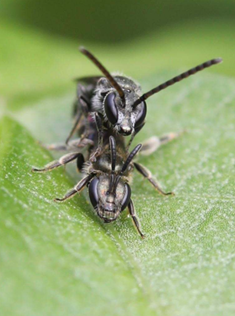 Ground-nesting bees are often described as solitary, but nature rarely fits neatly into the categories we create.
While many species do indeed live independently, some show behaviours that blur the line between solitary and social life. In certain species, females may share nest entrances while maintaining separate brood chambers underground. Others exhibit forms of primitive eusocial behaviour, where individuals cooperate to a degree that resembles the early evolutionary stages of sociality.
These species may offer valuable clues about one of biology's most important questions: how truly social insects such as honeybees, ants and termites evolved from solitary ancestors.
Choosing a Safe Neighbourhood
Finding a suitable nesting spot is critical. A poor choice can mean losing an entire brood to predators or parasites.
Emerging evidence suggests that some bees may assess potential nesting sites for signs of danger before settling down. They appear capable of detecting cues that indicate the presence of parasites or previous nesting failures, potentially avoiding areas where the risks are too great.
The idea that a bee might assess the risks of a nesting site may seem surprising, but choosing where to raise the next generation is one of the most important decisions it makes. How bees recognise potential threats, what warning signs they look for, and whether these choices improve their chances of success are all topics that scientists are only beginning to explore.
Parasites and positive signals
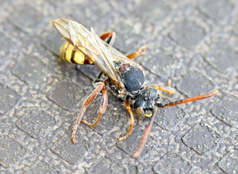 Life underground is far from peaceful. Many solitary bees face an astonishing array of parasites that have evolved to exploit their nests. Some bee species such as Nomada bees act as "cuckoo bees", laying their eggs in the nests of other bees and leaving the host to provide food for their offspring. The host's carefully gathered pollen provisions ultimately nourish the intruder instead.
But cuckoo bees are only part of the story. Bee flies hover over nest entrances, flicking their eggs into burrows. Oil beetles employ an even more remarkable strategy. Their tiny larvae climb flowers and wait for visiting bees, hitching a ride back to the nest where they consume the provisions intended for the bee's own offspring.
Yet these parasitic species are not all bad news, instead they might prefer to be understood as indicators. Signals to researchers that there are numerous solitary bees in a given habitat where these parasitic species are spotted.
Going beyond the surface level
What makes ground-nesting bees so exciting isn't simply their diversity, although Britain alone has dozens of species with different nesting habits, life cycles and ecological requirements. It's the sheer number of unanswered questions.
Farmland covers a huge proportion of the British landscape, yet we still have limited understanding of how many solitary bee species use farmland soils, which conditions they require, and how best to support thriving populations.
The GWCT Solitary Bee Appeal aims to change that. By supporting research into solitary bees within farmland systems, the appeal will help uncover the hidden lives of these remarkable insects and provide the evidence needed to conserve them effectively.
Further reading:
Benton, T. and Owens, N. (2023) Solitary Bees. New Naturalist Library 146. London: William Collins.
Falk, S. (2019) Field Guide to the Bees of Great Britain and Ireland. London: Bloomsbury Publishing.
Hanson, T. (2018) Buzz: The Nature and Necessity of Bees. Duxford: Icon Books.
Photo credits
Ellie Ness: (1 Pantaloon bee) (2 Mining bee) (3 Furrow bees) (4 Nomad bee) (5)