Joe Stanley, Head of Sustainable Farming, The Allerton Project
September sees the opening of the second application window for SFI26, the fifth iteration of England’s post-Common Agricultural Policy (CAP) scheme intended to provide environmental benefits alongside supporting food production and productivity.
For 35 years the Allerton Project has been at the forefront of providing the evidence base upon which the modern agri-environmental scheme stands, and we strongly believe that a well-planned and executed scheme returns multiple benefits to the farm business:
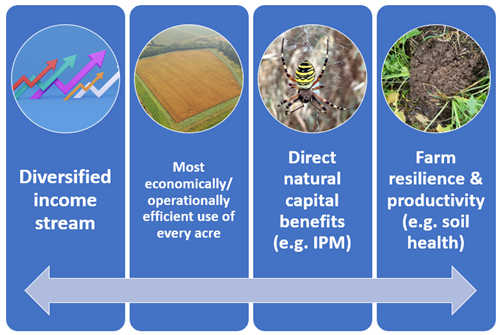
As such, when the £260m window does open we’re prepared to submit an ambitious scheme which nevertheless balances our farm’s twin priorities of food production and positive environmental outcomes to replace our existing Mid-Tier scheme dating from 2020.
However, even a relatively modest 320ha farm such as the Allerton Project finds itself easily approaching the £100,000 annual agreement cap now instituted for SFI, and that doesn’t take into account area options such as CIPM3 (Companion Cropping) and CIPM4 (No Insecticide) currently covered under an SFI23 agreement with twelve months left to run. As related in June’s blog SFI: A decade on, still not delivering - Game and Wildlife Conservation Trust the political and budgetary constraints under which SFI is operating will therefore inevitably stifle the good it can achieve across our whole landscape. In reality – and depending on the average size of schemes submitted – there is only enough money in Window 2 for some 3000-6000 successful applications.
We are also being forced to economise the scheme due to a combination of factors, reducing particularly our area of herbal ley (CSAM3) winter bird food (CAHL2) and legume fallow (CNUM3) compared to our expiring Mid-Tier scheme. These options are seeing a 40%, 25% and 10% cut in their respective payments rates (below the previously used income forgone level), and our experience of them over the past five years has been challenged by climate change. Given our low livestock numbers, it becomes an easy decision to remove CSAM3 entirely from the rotation, but it was a difficult decision to reduce the area of winter bird food we provide given that we know how beneficial it is for our farmland birds. However, with increasingly frequent drought conditions often forcing multiple re-drillings, we as a farm business need to attempt to reduce our exposure to risk. We’re also looking at wider use of grass margins vs wildflower areas, again due to the challenges on our heavy clay soils of achieving good outcomes, trading lower payment rates for simpler scheme administration.
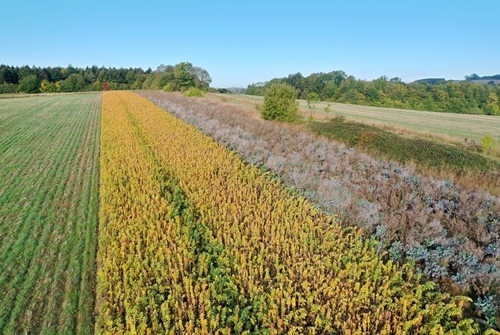 Winter bird feed at the Allerton Project, 2025.
At a time when farm economics have, for many, rarely looked so parlous, the relative security of regular cashflow (hopefully!) to be provided by SFI26 will however be a most welcome addition to most farm businesses’ forecasts.
However, 2026’s drought conditions have seen government, once again, fail to offer any meaningful support to farmers (in contrast to those in other parts of the world) and instead largely signpost a slightly more generously funded SFI Window 2 as evidence that Defra is responding to unprecedented market conditions. Yet SFI is not a crisis management tool; it’s a mechanism to incentivise farmers (and, it must be noted, many non-farmers too) to adopt more nature and climate friendly landscape management. Allocating an extra £50m in this application window (not that there were ever supposed to be application windows) is welcome in itself but will do nothing to help with the crisis many farms are facing: payments will not hit bank accounts until 2027, and are paid on an income-forgone basis.
True, many paid actions will improve farm resilience and reduce the impact of future bad weather, but those are benefits to be gleaned (on an uncertain basis) in the future, not today. While ironically, climate change will itself make those resilience gains even harder to achieve in a short timescale.
It was, of course, welcome to see Defra (and the Prime Minister) talking more energetically about installing more reservoir and water storage capacity on farms, but once again these are both promises of jam tomorrow and perhaps an attempt to sidestep the fact that irrigation will never be a major element of UK farming; today only some 0.5% of farmed land is irrigated, and it’s pretty difficult to imagine an economic case for widespread irrigation of UK combinable crops and grass.
The realities of a changing climate are with us; whole percentage points of GDP are already being knocked off economies across Europe from this single drought, with 2027 expected to be even more extreme due to an historically powerful El Niño. I can only hope that this new reality will begin to seep into the thinking of both the Treasury and the wider food supply chain so that a slight shuffling of the SFI budget will become merely the smallest downpayment on the sort of historic investment needed to take our food, farming and environmental management toward the sort of war footing required to meet the challenge facing us in the next decade.