By Jayna Connelly, Science Communicator
When the Allerton Project began in the early 1990s, the aim was to understand how farming methods, habitat management and predator pressure influence the wildlife and environment on this 320-hectare demonstration farm in Leicestershire. As part of this, the birds have been surveyed every year since 1992 by the same two researchers, Chris Stoate and John Szczur. Over 30 years later, this continuity gives the dataset a level of reliability that is almost unheard of in farmland ecology.
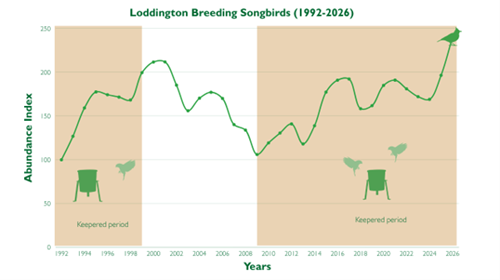
The latest Defra wild bird statistics show that the UK farmland bird index has declined by 63% since 1970, with further declines recorded in recent years. Against that backdrop, the long-term trends at Allerton provide a striking contrast. Overall, songbird abundance on the farm is now almost 145% higher than when monitoring began in 1992, suggesting that local management can sometimes help offset wider national pressures.
Two complementary monitoring methods help build this picture. Breeding bird territory mapping is carried out during spring and measures the number of breeding pairs established on the farm. Alongside this, annual abundance monitoring records the overall numbers of birds using the farm, including non-breeding individuals. While the two datasets often tell a similar story, they measure different aspects of bird populations and occasionally reveal different responses to management.
The early years of the project were particularly revealing. From 2001 to 2010, no predator control was carried out at Allerton. This was deliberate: the farm was in the middle of a major trial designed to understand how predator pressure affects breeding success. Because habitat management and farming practices remained broadly consistent, this created a rare opportunity to examine how bird populations responded when just game-related management was removed. As seen in the GWCT latest publication Game for Nature, the role of Game management for farmland bird species plays a crucial role.
The highest year on Allerton records for Songbirds
The clearest headline from more than three decades of monitoring is that farmland songbirds at Allerton are now at their highest level since records began in 1992 and well above previous peaks recorded during the late 1990s and early 2000s. Direct comparisons with Defra’s latest statistics should be made with caution because the datasets operate at different scales, but the contrast highlights how dramatically the trajectory at Allerton differs from the broader national picture.
While individual species have responded differently and a range of factors contribute to these trends, the long-term data suggest that the combination of habitat creation, winter food provision and targeted predator management associated with game management has played a major role in driving this recovery. Notably, the strongest period of growth has occurred since predator management resumed following the experimental withdrawal period between 2001 and 2010, with overall songbird abundance increasing by almost 85% since 2011.
Species which show the positive impact of farming and game management practice
The results are most obvious in species such as song thrush and blackbird. Song thrush territories increased from 14 in 1992 to 64 by 2001, before falling sharply during the period without predator control to just 15 territories in 2010. Following the resumption of management, numbers recovered to 44 territories in 2015 and reached 60 by 2021. Blackbirds showed a remarkably similar pattern, increasing from 66 territories in 1992 to 143 in 2001, falling to 69 in 2010 and recovering to 121 by 2021. These trends stand in contrast to wider national declines and their resilience at Allerton is a clear demonstration that predation has a critical impact on population levels of certain species, and that targeted management can make a measurable difference.
Predator management at Allerton extends beyond fox control alone. Fox numbers in the local landscape are relatively low, which may help ground-nesting birds. Spring Larsen trapping helps reduce magpie numbers, while carrion crow control seeks to limit another important nest predator. Together with habitat creation and winter food provision, these measures form part of the wider three-legged stool of management practices that are often associated with lowland game management. The key is not any single intervention, but having the flexibility to apply the right management tools in the right place when evidence suggests they can benefit wildlife.
At the same time, the relationship between predators and conservation is rarely straightforward. Jay populations have increased locally alongside maturing woodland and agroforestry habitats. Jays perform an important ecological role by dispersing acorns and helping oak establish naturally across the landscape, but they are also recognised nest predators. Previous research has identified jays as significant predators of woodland birds, including spotted flycatchers. In England, jays are among the species that may be controlled under General Licence GL40 in specific circumstances for the conservation of wild birds and other wildlife. This does not necessarily mean they require control in all cases but as habitats improve for some species, they may also improve for certain predators, creating a continual balancing act for conservation managers. They are not inherently "good" or "bad" for conservation; rather, it highlights the complexity of managing ecosystems where the needs of different species can sometimes conflict.
Few species illustrate this more clearly than the spotted flycatcher. Territory mapping recorded eight territories in 1992 and 14 by 2001. During the period without predator control, the population declined dramatically to a single territory in 2010 before recovering to 10 territories in 2015. By 2021, six territories remained. Given the severe national decline of this species, maintaining a breeding population at Allerton remains highly significant and supports earlier research showing improved nesting success when predators are effectively managed, particularly in woodland habitats.
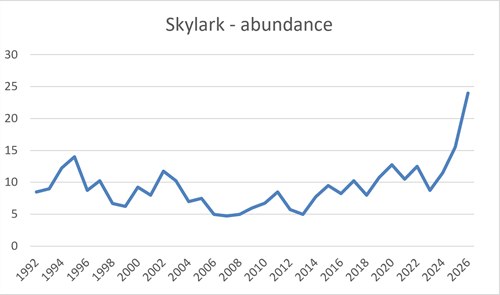
Skylarks present a more nuanced picture. Territory mapping suggests that breeding numbers have remained broadly similar to those recorded when monitoring began, with around 36 territories in 1992 and 35 recorded in 2021. However, the territory data also show a noticeable decline during the period when predator management was experimentally withdrawn between 2001 and 2010, followed by recovery once management resumed. Abundance monitoring tells a slightly different story, indicating a substantial increase in the overall number of skylarks using the farm and reaching its highest recorded level in 2026. The difference between these measures suggests that while the number of breeding territories has fluctuated over time, the farm may now be supporting more skylarks overall than in previous decades. This likely reflects the combined benefits of predator management and changes in farming practice. Direct drilling, stewardship habitats and herbal leys provide improved nesting and foraging conditions, while successful predator management may help more nesting attempts survive. An unusual farming year with a high proportion of spring cropping may also have affected early nesting and territory establishment in 2021, highlighting how skylark numbers can respond to both management and annual farming conditions.
Linnets have been another success story. Territory mapping shows an increase from 10 territories in 1992 to 25 territories by 2001 and more than 20 territories in recent years. Abundance monitoring suggests even higher peaks, starting at a low of 5 birds and increasing to more than 30 birds recorded in some recent years. The difference between the datasets reflects the fact that territory mapping estimates the number of breeding territories present, whereas transect counts record all birds detected during the surveys, including non-breeding individuals and birds moving through the site.
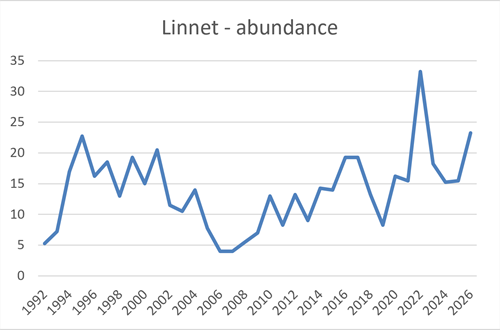
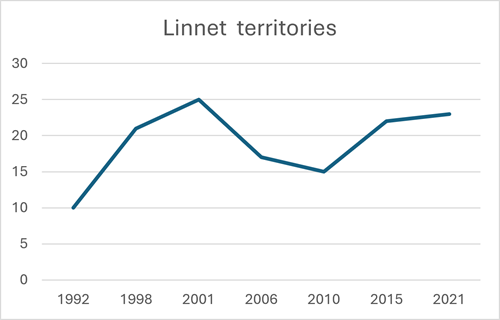
Linnets are particularly interesting because they are essentially nomadic birds. During winter they move widely in search of food before breaking into breeding pairs in spring. If breeding fails, birds may relocate and seek out other areas with successful pairs, meaning successful breeding areas can attract additional birds and gradually build local populations. At Allerton, a combination of winter bird food, structurally diverse hedgerows and reduced nest predation may have worked together to create conditions in which linnet populations could grow over time.
Wild bird food habitats are likely to be an important part of this story. They provide vital seed resources during winter for species such as linnet, yellowhammer and reed bunting, but they also support insect populations that become important food for some chicks during the breeding season. In many cases, habitat provision and predator management are not competing explanations for population change but complementary ones.
Reed buntings provide a good example. Territory mapping suggests a positive long-term trend, rising from three territories in the early years of monitoring to 13 territories by 2021. However, abundance-index data show that overall numbers remain relatively low and fluctuate considerably between years. Together, the datasets suggest that reed buntings have responded positively to habitat provision and winter feeding opportunities, but that other limiting factors continue to operate. Their gradual recovery is a reminder that some species have very specific ecological requirements that are not always easy to deliver at scale.
Bird species that have failed to increase breeding territories
Perhaps the most intriguing result emerges from yellowhammers. On first inspection, the two datasets appear to tell slightly different stories. Territory mapping indicates a relatively stable breeding population, with 57 territories recorded in 1992 and 55 recorded again in 2021. In contrast, abundance-index data suggest lower numbers than those seen during the species' peak years and considerable fluctuation over time.
Rather than being contradictory, these findings may reveal different aspects of the population. The breeding population has remained more resilient than national trends might lead us to expect, but overall use of the farm appears to have varied over time. Stewardship habitats, winter bird food, hedge management and predator control, yellowhammers may have not have produced sustained growth, but the relatively stable numbers are somewhat remarkable when compared to Defra’s Wild Bird trends. This mirrors wider research, including the recent paper by Niamh et al. in Ecological Solutions and Evidence, which showed that yellowhammers face multiple interacting pressures that are not easily solved by single interventions. The team at Allerton continue to study the population dynamics and habitat preferences of this species in detail to help build our understanding of this iconic but struggling species.
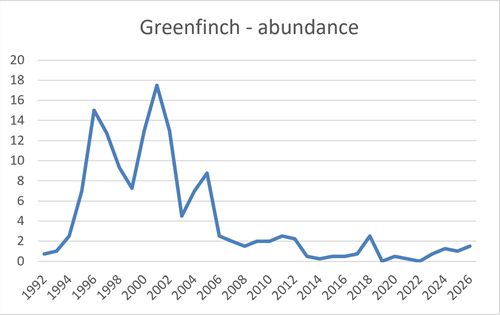
Greenfinches and chaffinches tell a different story again. Here the Allerton data closely mirror national trends. Greenfinch territories increased from 15 in 1992 to 62 in 2001 before falling dramatically to just four territories by 2021. Chaffinches peaked at 229 territories in 2001 before declining to 72 by 2021. A similar story is reflected by the abundance data. Disease, particularly trichomonosis in greenfinches, is widely considered to be a major driver of these declines. While habitat creation cannot prevent disease outbreaks, habitats such as wild bird seed mixes, weedy margins and diverse grasslands can help provide food resources across the wider landscape. This may reduce reliance on concentrated feeding locations where large numbers of birds gather together, while simultaneously helping address seasonal food shortages.
Indeed, both winter feeding and predator management are directly associated with lowland game management systems. While implemented primarily to support gamebird populations, the long-term monitoring data from Allerton suggest that many farmland bird species can also benefit from the habitats, food resources and improved breeding opportunities created through these approaches.
Long-term monitoring at Allerton suggests that maintaining released gamebird management may be more important now than ever. There is an irony in the fact that the Allerton Project which has helped generate much of the evidence underpinning modern agri-environment options was unable to access the latest round of funding for the Sustainable Farming Incentive (SFI). Many of the management practices associated with successful farmland bird conservation, including wild bird feeding, habitat creation and carefully targeted predator management, are funded through a mixture of agri-environment schemes and private investment from sporting interests. At a time when Environmental Land Management and SFI schemes have experienced considerable uncertainty, the private investment in conservation from gamebird management is even more critical.
What we’ve learnt from the Allerton Project’s farmland birds
What makes the Allerton Project exceptional is not simply the length of the dataset, but the way it allows local changes to be interpreted within a national context. In many cases, the farm mirrors wider trends. Willow tit has disappeared from the monitoring area, reflecting a severe national decline. Tree sparrows have fallen from earlier highs, while greenfinches and chaffinches have followed disease-driven declines seen across much of Britain. At the same time, species such as song thrush, blackbird, linnet and spotted flycatcher have performed more strongly than national trends might have predicted. These local recoveries suggest that evidence-led management can make a meaningful difference even where national populations remain under pressure.
In many cases, several factors act together, making it difficult to separate individual causes from wider environmental influences. The comparison between territory mapping and abundance monitoring illustrates this particularly well. While the two approaches often tell a similar story, in some cases they highlight different aspects of population change, helping us distinguish between changes in breeding populations and changes in how birds use the wider farmed landscape.
Long-term datasets such as Allerton's provide evidence not only of what works, but also of what could be lost if effective management options become less widely available. Evidence-led habitat creation, reliable winter food supplies, carefully targeted predator management and continued monitoring have all contributed to the story at Allerton. The challenge now is ensuring that the tools needed to deliver those benefits remain available in the future.
This is particularly relevant to Defra's current call for evidence on gamebird release, shooting and welfare in England, which is seeking information on both the positive and negative impacts of gamebird management on biodiversity and the wider environment. Long-term datasets such as Allerton's cannot answer every question, but they do provide valuable evidence that activities associated with game management, including winter feeding, habitat provision and predator management, can produce measurable benefits for a range of non-game species as well as gamebirds themselves.
Linking agri‐environment scheme habitat area, predation and the abundance of chick invertebrate prey to the nesting success of a declining farmland bird - McHugh - 2022 - Ecological Solutions and Evidence - Wiley Online Library