The Game & Wildlife Conservation Trust (GWCT) has published a new report titled ‘Game for Nature: Why released gamebird management is a lifeline for farmland biodiversity’, based on decades of scientific research on pheasant releasing. In light of Defra’s recent call for evidence, it demonstrates the huge private investment in nature recovery that gamebird management represents.
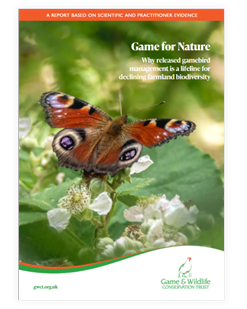 GWCT Chief Executive Nick von Westenholz said: “The work that goes into released gamebird management and how it benefits wildlife is little understood by policymakers and the wider public. Gamekeepers don't simply release pheasants and partridges into the countryside and walk away. To sustain their birds, they create and maintain woodlands and hedgerows, distribute food during winter and provide protection from predators and these activities have been scientifically proven to benefit wildlife. As the report makes clear, this amounts to a significant private investment in nature conservation, which is essential if the government is going to meet its legally binding biodiversity targets by 2030.”
The document explains, with reference to peer-reviewed science carried out by the Trust over 25 years, the many ways in which farmland managed for gamebirds has created space for nature. Most significantly, management associated with released game carried out by gamekeepers at the GWCT’s Allerton Project demonstration farm has bucked the national trend by more than doubling the number of breeding songbirds.
Another study showed 15 times more butterflies, 40 times more bumblebee and 90% more weed species in game crops in summer than in neighbouring arable crops, and a research project looking at the use of game crops in winter recorded up to 100 times as many songbirds per hectare. GWCT research found there is up to 65% more hedgerow per square kilometre on estates with released-gamebird management. Another study showed songbirds account for one in four visits to feed hoppers for pheasants filling the hungry gap in late winter/early spring and surveys show woodlands managed for pheasants have 32% more wild birds, twice as many butterflies than typical UK woods.
The report acknowledges the potential negative effects of releasing, but recognises that the evidence shows these tend to be located around pen and feed sites, and their effect can be minimised by releasing in accordance with GWCT best practice guidelines. At the same time, many of the positive effects are at a whole farm or landscape scale.
GWCT Director of Advisory Dr Roger Draycott said, “Gamebird releasing is sometimes unfairly blamed for negative environmental impacts including increasing the fox population, reducing insect populations or spreading Avian Influenza, but there is little evidence for this. Such claims ignore the fact that with careful release site placement and adherence to best practice guidelines, any damaging impacts can be mitigated. Conversely, provided game managers follow best practice guidance, within the wider countryside the impact for invertebrates, songbirds and a host of other wildlife is overwhelmingly positive.
Gamebird management is helping boost biodiversity alongside productive farming at the scale required for national nature recovery. This report will help policymakers, conservation organisations and the wider public to understand the huge contribution to public goods it represents at no cost to the taxpayer.
Read the Game for Nature report here.
Download a copy of the Game for Nature report here.
Please watch the explainer video below.
Further reading
Notes to editors
The Game & Wildlife Conservation Trust – providing research-led conservation for a thriving countryside. The GWCT is an independent wildlife conservation charity which has carried out scientific research into Britain’s game and wildlife since the 1930s. We advise farmers and landowners on improving wildlife habitats. We employ more than 60 post-doctoral scientists and other research staff with expertise in areas such as birds, insects, mammals, farming, fish and statistics. We undertake our own research as well as projects funded by contract and grant-aid from Government and private bodies. The Trust also has a dedicated professional advisory service to make sure that the results of its research are easily available to farmers, landowners, gamekeepers, and others delivering practical conservation.
For information, contact:
Joe Dimbleby, Head of Communications
Telephone: 07708 200856
Email: jdimbleby@gwct.org.uk