Saving a magical moorland icon
 The Merlin Recovery in Northeastern England Project is funded by Natural England’s Species Recovery Programme.
Merlin returned to the Red list of Birds of Conservation Concern in 2015 because their population was failing to recover from historic declines. Moorlands in northern England are an important stronghold for the remaining breeding population, and a factor limiting recovery is over-winter survival when birds leave these habitats.
This project aims to utilise GPS technology to better understand winter movements, survival and causes of mortality of juvenile merlin. The GWCT team will work with raptor workers and land managers to assess the use and importance of non-burn heather patches provided as a conservation tool for nesting merlin, to better inform conservation management.
You can follow our story here, if you are interested in learning more about who we are and what we’re aiming to achieve through this project.

About merlin
Falco columbarius (Linnaeus, 1758)
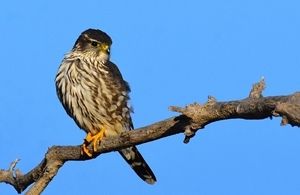 Merlin are iconic falcons of moorlands and are the UK’s smallest bird of prey, with males being only slightly larger than blackbirds. They mainly hunt small birds such as meadow pipits and skylarks, sometimes hunting other species such as starlings, small waders, and insects such as fox and emperor moths.
The UK is at the south-west extremity of the merlin’s European range and the population here is thinly scattered across upland moorland from south-west England to Shetland. In winter, there is also an influx of merlin that breed in Iceland, which migrate to the UK to spend the winter in a warmer climate where small birds are likely to be more plentiful.
Merlin typically nest on the ground amongst tall heather, but in several regions will also nest in trees using old crow nests. They lay 3-5 eggs and chicks normally fledge within 25-32 days, being fully independent about a month after that. In 2017, the British Trust for Ornithology estimated that for every breeding attempt an average of 1.5-2 merlin chicks fledged, suggesting that chick survival may be low and could be limiting population recovery.
Project objectives: GPS tagging and non-burn heather patches
The project has two main objectives:
- To fit GPS-GSM transmitters to a sample of juvenile merlin to monitor movements and survival.
- To assess the effectiveness of non-burn heather patches provided as a conservation tool to provide nesting habitat for breeding merlin on heather moorland.
GPS tagging
The Merlin Magic project (2021-2022) concluded that the main factor limiting merlin population recovery was over-winter survival when birds leave their moorland breeding habitats.
Phase one of this new project aims to fit a sample of juvenile merlin with GPS transmitters, under licence, to monitor movements and survival. Birds will be followed remotely all year round, with movements used to assess winter feeding habitats and nest habitat selection on heather moorland. They will also allow survival rates to be calculated, with any dead birds recovered to ascertain cause of death. This information will help inform conservation strategies for merlin.
Non-burn heather patches
The second phase of the project aims to collect evidence to assess whether non-burn heather patches on heather moorland in northern England are used by breeding merlin. Non-burn patches are areas of heather typically one hectare in size, which are deliberately not burned to provide breeding habitat for merlin.
We will identify and map non-burn heather patches from moorland management plans, and land manager and Natural England records. We will liaise with raptor workers and land managers to collect 50-100 merlin nest locations and breeding success data in relation to these non-burn heather patches. We will also collect data on heather height, age and patch size of non-burn areas at known nests to assess whether non-burn areas provide favourable habitat. This project will provide evidence to help Natural England and land managers provide suitable breeding habitats as a conservation tool for breeding merlin.