By Jayna Connelly, Science Communicator
This year, I attended my first partridge count. As a researcher myself, but having since moved into communicating our science, I was hungry for any experience that made me feel like I was out in the field again. As we drove across fields in the beautiful Sussex countryside, I felt truly blessed to be part of a scheme that gives us such an incredible insight into a special bird, while contributing to a dataset that is unlike many others.
The key thing to remember, however, is that I’m not all that special - anyone can be part of this. Anyone can contribute to this data by signing up to the Partridge Count Scheme.
The insights I never expected from the grey partridge count
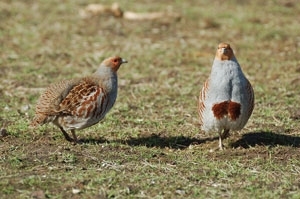 The scheme has been running for over 90 years, and it has given us incredible insights into the population dynamics of the grey partridge. This bird acts as an umbrella species, representing good habitat, healthy insect populations and adequate predation management. The grey partridge has been struggling for many years. As a ground-nesting bird, they are particularly vulnerable to predation and nest disturbance. But it’s not until you spend time on the ground with them that you realise just how crucial easily overlooked features are for their survival.
Meandering hedgerows and field margins are essential for partridges to forage safely, the straighter these field boundaries are, the easier their predators find patrolling them. Simultaneously, cover mixes that include a variety of flowering species and vegetation of different ages in margins or scrubby field corners make a habitat truly ideal.
Beyond this, the experience of partridge counting really highlighted the assumptions I have been working on up until now. When I think of a bird roosting, I imagine it hopping onto a perch or settling into a tree for the night. With grey partridges, it’s easy to forget that they aren’t going to suddenly diverge from their niche, leave the ground, and sleep in trees.
So, where do they sleep?
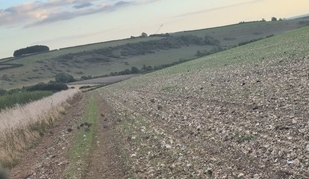
Grey partridges sleep in the centre of fields, a practice known as ‘jugging’. The clearer and more open it is, the better, because it allows them to see predators approaching. This is what I realised as I watched them emerge from their daytime hiding places and foraging areas, before making their way out into the open as dusk fell. And that highlighted the first of a few key lessons I learnt whilst out on my first count: timing is everything.
Start your survey too soon in the afternoon and you’ll miss the partridges emerging. If, like me, you’re keen to get outside, there’s nothing wrong with checking back over your first field after you’ve surveyed a few more, just to make sure you haven’t missed any.
Speaking of not missing them, ageing partridges and collecting accurate data is another important part of the count. If you know you’ve seen a covey with, say, one male, one female and five chicks, and then you see the same group later, slightly further down the field, or even in the same spot, you know you’ve probably already counted them.
Grey partridges are great dads! Why is this important?
 Sexing and ageing partridges is a challenge. Unlike my passionate and esteemed colleagues, I’m not quite the dab hand at it - yet.
Just how variable the adults can be within a covey is something I hadn’t fully appreciated before. What I’ve learned that partridges can form remarkably strong pair bonds. They are arguably more loyal than humans and, indeed, much of the animal kingdom. How far you take that comparison between humans and partridges is up to you!
But there’s an interesting reason why the composition of a covey can be more complicated than simply one male, one female and several chicks.
Confusingly, sometimes you might see a male, a female, some chicks, and another male. This can happen if a female is lost on the nest. The remaining male is left alone and will join another covey in improve its chances of survival. “Extra” males or females in coveys can give us an indication of predation pressure in an area. If you have a lot of coveys containing additional males, it may suggest that females are being lost at a higher rate. A somewhat idealistic way of looking at it then, is that the fewer additional males you find in each covey, the more successful your local game management is at protecting your grey partridges – particularly the hens on a nest. I think this is a fantastic example of just how much these birds can reflect our wider landscape and our relationship with it.
Not only do covey demographics reflect our investment in these birds and the wider landscape, but our insights also reflect the passion, expertise, and time that people are willing to dedicate to monitoring this iconic species.
The nitty gritty on grey partridge identification, sexing, and aging
At a distance a thistle can look an awful lot like a grey partridge in low light – I guess that is a sort of “if you know, you know” observation but if you can look beyond the thistles this is what you actually need to know.
At first glance, identifying a grey partridge seems straightforward. They’re a small, stocky, brown-and-grey bird, with that distinctive orange-brown face, barred flanks and, in the right light, that famous horseshoe on the belly. But once you start trying to tell individuals apart, you realise there’s considerably more going on.
There are a few features to look for, and the important thing is not to rely on just one of them.
For sexing adults, the face can give you a good starting point. Males tend to have a more orange-buff face, with a longer, more pronounced eyebrow and that striking red skin around the eye, particularly during the breeding season. Females tend to have a more orange-brown face and, usually, a noticeable white eyebrow – though that can be hard to see in certain light.
Then there’s the horseshoe, probably the feature most people associate with telling a male from a female. Males have that prominent chestnut-brown or dark horseshoe on the belly, whereas females usually have just a few dark spots.
But, and this is where it gets slightly more complicated, you can't simply look for a horseshoe and declare, “male!” Some females have a small horseshoe, and a few can even have a surprisingly impressive one, others have none at all!
For the most part it is easy enough to work out but if you really want to be confident, you need to look at the wing feathers as well. The reliable feature is something called the “Cross of Lorraine”. On the shoulder feathers, or scapulars, females have distinctive cross-bars branching away from the central pale shaft streak. Males don't have those cross-bars at all.
So, essentially, you're looking at the face, the belly and then, if you can get a good enough view, the wing pattern and putting all those clues together.
And then there's ageing.
This is where it gets even more interesting, because a young partridge doesn't simply wake up one morning and decide to become an adult. They go through a gradual, but complete, moult in their first calendar year, and if you know what you're looking for, those changing feathers can tell you roughly how old a bird is.
Young birds start moulting surprisingly early. By around eight weeks, the scapulars and wing coverts are beginning to change, and by around nine to ten weeks the breast feathers, including the horseshoe, are being replaced. By about 13 weeks, they've acquired their adult facial feathers, although the whole process continues for several more weeks after which they will look exactly like their parents.
Even the legs can give you a clue. Juveniles tend to have yellow-brown legs, which gradually become greyer as they move into their second calendar year – I.e. January after they hatch. But, as with everything else, there are caveats, particularly later in the winter, when leg colour becomes much less useful for ageing.
It's a bit like putting together a puzzle. The face, belly and legs each provides a puzzle piece, and the age of the bird changes what all those features look like.
A closing note for EVERYONE
 Whether you’re aware of grey partridges in your area or not, zero counts are just as important as one with coveys recorded, and a count of one covey is just as important as 30 if what you are doing is starting on the journey of grey partridge recovery. If we can identify the areas where these birds are on the brink of disappearing, we can focus our efforts on helping them expand their range once more.
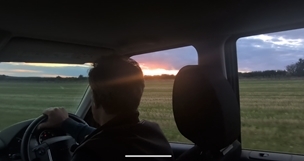
It’s not too late to submit your count, although the later you leave it the more the chicks look like adults. So, if you have one evening, a 4x4, a pair of binoculars and a map, you too can enjoy the pleasure of being part of the Partridge Count Scheme.
To sign up and join the count visit: Join the Partridge Count Scheme - Game and Wildlife Conservation Trust.